
Water Leaks in NSW Strata Buildings: Who Is Responsible and What Are Your Rights?
- Home
- Water Leaks in NSW Strata Buildings: Who Is Responsible and What Are Your Rights?
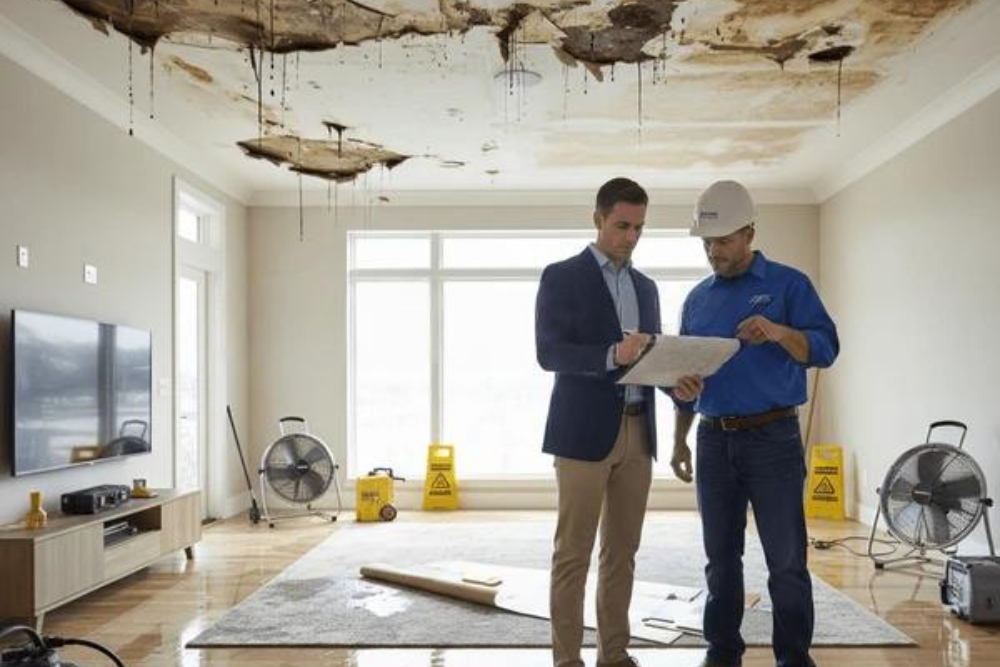
Water ingress is the single most common source of strata disputes in NSW strata schemes. The short answer: if the leak comes from common property, such as the roof, external walls, windows, floor slabs, balconies, or waterproofing membranes, the owners corporation may be liable to repair it and pay for it. If the leak comes from fixtures inside your lot, the responsibility is yours. The owners corporation’s duty to maintain and repair common property under section 106 of the Strata Schemes Management Act 2015 (NSW) is strict, and since the 2025 strata reforms, lot owners now have six years to claim compensation for losses caused by a breach of that duty.
This guide explains how responsibility is determined, what compensation you can claim, and the exact steps to take when an owners corporation refuses to act.
Who is responsible for a water leak in a strata building in NSW?
Responsibility follows the source of the leak, not the location of the damage. Water that ends up staining your ceiling may have travelled from a failed membrane three floors up, which is why identifying the source, usually with a plumber’s or engineer’s report, is always the first step.
Generally speaking, and subject to my comments below, the owners corporation is responsible when the leak originates in common property which the owner is not responsible for including:
- The roof, guttering and external walls;
- Drainage pipes;
- Windows and doors in the external walls (in most schemes registered after 1974);
- Structural floor slabs and common boundary walls between lots;
- Waterproofing membranes in bathrooms, balconies and planter boxes (in most cases);
- Pipes and services located in common property or servicing more than one lot.
The lot owner is responsible when the leak originates within their lot, such as leaking taps, toilet cisterns, shower fittings, appliance hoses (a burst washing machine hose is a classic example).
The liability depends on the registered strata plan, the by-laws, and any common property memorandum adopted by the scheme. Balconies and planter boxes can be a grey zone, as the waterproofing membrane and slab are ordinarily common property, while planter boxes may be the owner’s property and responsibility in some cases.
The owners corporation’s duty to repair is strict
Section 106(1) of the Strata Schemes Management Act 2015 requires the owners corporation to properly maintain and keep in a state of good and serviceable repair the common property, and to renew or replace fixtures where necessary.
The courts have consistently held that this duty is strict. It is not a duty to take reasonable steps — it is a duty to keep the common property in repair, full stop (Seiwa Pty Ltd v Owners of Strata Plan 35042 [2006] NSWSC 1157). An owners corporation cannot excuse a failure to fix a leak by pointing to:
- A lack of funds or a reluctance to raise a special levy;
- Difficulty finding contractors;
- A general meeting resolution to defer the works;
- A belief that the problem “isn’t that bad.”
The Act allows deferral of repairs in only narrow circumstances, and the Strata Schemes Legislation Amendment Act 2025 tightened those further. An owners corporation now cannot defer action where doing so affects safety.
What compensation can a lot owner claim?
Under section 106(5), an owner who suffers loss because of the owners corporation’s failure to repair can recover any reasonably foreseeable loss as damages.
Recoverable losses commonly include:
- lost rent where a tenant vacates or the lot becomes unlettable;
- alternative accommodation costs for owner-occupiers forced to move out;
- the cost of repairing lot property, e.g. repainting, replacing carpet, mould remediation;
- damaged belongings;
- expert report and investigation costs;
- pre-litigation costs.
These claims are usually determined by NCAT, whose jurisdiction to award damages under section 106(5) was confirmed in Vickery v The Owners – Strata Plan No 80412 [2020] NSWCA 284.
A critical July 2025 change is that the limitation period in section 106(6) has been extended from two years to six years after the owner first becomes aware of the loss. This is a significant win for owners, as many meritorious claims previously failed simply because owners waited too long while the owners corporation “investigated”. If your loss arose before the amendment commenced and the old two-year window had already closed, the Court has confirmed the six year limitation period does not operate retrospectively, and you may therefore be out of time: John Goubran & Associates Pty Ltd 070 974 819 v The Owners – Strata Plan 57150 [2026] NSWDC 9.
What should you do if the owners corporation won’t fix the leak?
Follow this sequence. It builds the evidence trail NCAT expects to see:
- Contact your strata manager or the committee. You may also want to take photos, obtain a plumber to inspect the leak and provide a report to begin with, but you may also need a structural engineer to inspect and provide a report.
- Request a motion be added to the agenda of the next strata committee or general meeting. A refusal (or silence) strengthens your case.
- Consider applying for strata mediation with NSW Fair Trading. Mediation is compulsory for most strata disputes before NCAT will accept an application.
- If the above fails, you can apply to NCAT for the necessary orders.
- Sometimes in cases of serious dysfunction, you can apply to NCAT to seek to appoint a compulsory strata managing agent to manage the scheme’s functions and get the repairs done.
When is the lot owner liable for a leak?
If the leak comes from your lot, an appliance hose, an internal pipe servicing only your unit, or a bathroom you renovated, you are responsible for the repair and potentially for damage caused to other lots and common property. Owners also must not cause nuisance or hazard to other occupants (section 153), and an owners corporation can recover rectification costs from an owner whose works or neglect caused the damage.
Renovation history matters enormously. Many bathroom and balcony renovation by-laws transfer ongoing responsibility for the maintenance and repair to the renovating owner (and their successors in title). Before you buy, and before you renovate, check the by-laws. Note that under the 2025 reforms, a minor renovation application is deemed approved if the strata committee does not respond with written reasons within three months, but any conditions in the scheme’s renovation by-laws still bind you.
What if the leak is caused by building defects?
In newer buildings, persistent water ingress often points to defective original construction e.g. failed membranes, poor flashings, inadequate falls. Here the claim may lie against the builder, developer or another third party, not just the owners corporation:
- Statutory warranties under section 18B of the Home Building Act 1989 (NSW): six years for major defects, two years for other defects, from completion;
- the statutory duty of care under the Design and Building Practitioners Act 2020 (NSW), which reaches back a decade for economic loss caused by defects; and
- the strata building bond scheme for eligible high-rise buildings.
These deadlines are unforgiving. If your building is under ten years old and leaking, obtain legal advice before any window closes.
How Pobi Lawyers can help
Pobi Lawyers is a NSW strata specialist lawyers. We act for lot owners and owners corporations across Sydney and NSW in water ingress disputes, from initial demand letters and Fair Trading mediation through to NCAT orders, section 106(5) compensation claims and building defect proceedings. If water is coming into your lot and no one is taking responsibility, contact us for a fixed-fee advice before your evidence (and your limitation period) washes away.
Frequently asked questions
Who pays for ceiling damage caused by a leak from the unit above? It depends on the source. If water escaped from common property (a slab, membrane or shared pipe), the owners corporation is usually responsible. If it came from the upstairs owner’s fixtures, such as a burst flexible hose, that owner may be liable. Strata building insurance often responds to the resulting damage, but not to the cost of fixing the underlying defect.
Can I claim lost rent if my investment unit is damaged by a common property leak?
Lost rent is a classic reasonably foreseeable loss recoverable under section 106(5), provided you commence your claim within the relevant time limitation period after first becoming aware of the loss. It is best to obtain legal advice.
Do I have to attempt mediation before going to NCAT?
Yes, for most strata disputes.
NSW Fair Trading mediation is free, and NCAT will generally not accept an application without evidence that mediation was attempted. However, sometimes NCAT may permit an application to proceed straight to NCAT before mediation if mediation is unnecessary or inappropriate in the circumstances.
Is the owners corporation responsible for my leaking balcony?
Usually, the membrane and structural slab are common property, making the owners corporation responsible, but a common property rights by-law may have transferred that responsibility to a former or current owner. The registered strata plan and by-laws need to be reviewed to obtain a definitive answer.
This article is provided for general information purposes only. It does not constitute legal advice and should not be relied upon as such. Pobi Lawyers accepts no responsibility or liability for any loss arising from reliance on the information contained in this article.